
Cooper County Warrant Access
No official Cooper County active-warrant search page was located in the research. The Cooper County Sheriff's site had an inmate lookup navigation path, but no public warrant list or most-wanted page was found. That matters because a reader should not expect a single county database that confirms every active Cooper County warrant by name.
The practical search chain is court first, then clerk or sheriff confirmation. Search Missouri Case.net for the related criminal, traffic, or municipal case. Public docket entries may show a failure-to-appear warrant, capias, warrant return, bond entry, recall, quash, or withdrawal. For a known case, call the Cooper County Circuit Court at 660-882-2232. For custody or law-enforcement status, call the Cooper County Sheriff's Office at 660-882-2771 or the detention center at 660-882-6985.
The county warrant question can also be municipal. The Windsor Place Municipal Court page shows a local example where municipal payments are mailed to the Cooper County Circuit Clerk and the same court phone is used. A city citation from Boonville or another Cooper County community may need municipal-court contact even when payment or administration routes through the Circuit Clerk.
The manifest image for Windsor Place Municipal Court comes from the Windsor Place municipal court page, which is relevant because municipal warrants may follow local ordinance or traffic cases.
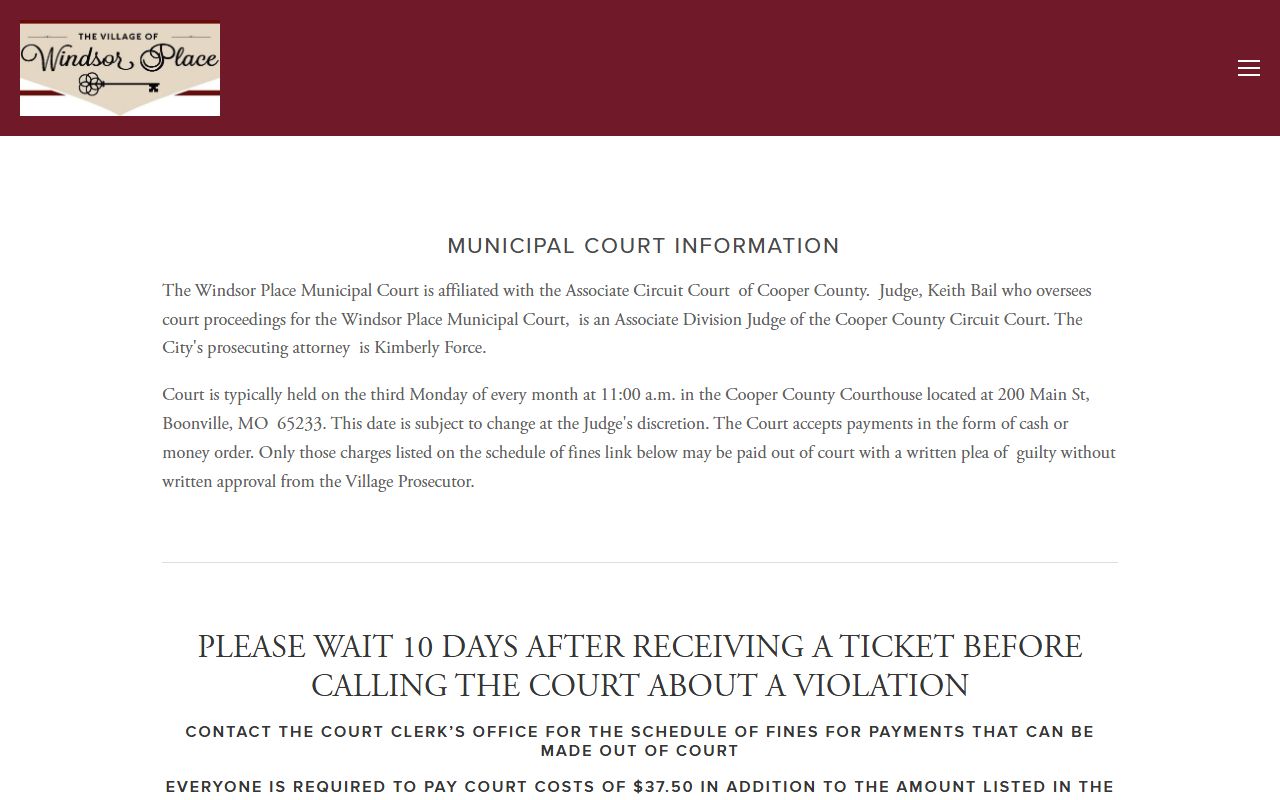
That municipal example supports the broader Cooper County warrant search rule: start with the court tied to the ticket or case, then verify active status before acting on a docket entry.
Cooper County Warrant Types
Warrant language can be brief in court records. Case.net may show a docket entry without giving the full law-enforcement detail. Use the type of case, the docket text, and any bond or return entry to understand what the warrant likely means.
- Arrest warrant is issued on probable cause for an alleged offense.
- Bench warrant or capias is issued by a judge after failure to appear, failure to comply, probation issues, contempt, or unpaid court obligations.
- Search warrant authorizes a search of a place or item and may be sealed before execution or return.
- Fugitive warrant relates to another jurisdiction seeking custody.
- Municipal warrant may arise from an ordinance or traffic matter in a municipal division.
For Cooper County warrant records, the safest distinction is between a court event and an arrest-status confirmation. A docket can say a warrant was issued, served, recalled, or quashed. Only the controlling court or law-enforcement agency can confirm whether action is still pending at the time of the call.
How to Search Cooper County Warrants
A Cooper County warrant search should follow the case trail. If the warrant came from a missed court date, unpaid payable traffic matter, probation entry, or pending criminal charge, the case record is usually the best public starting point. If the person may already be in custody, the sheriff or detention center is the better first call.
- Search Case.net by case number or litigant name and narrow to Cooper County or the 18th Judicial Circuit where the portal allows it.
- Open the public case and review docket entries for warrant, capias, failure to appear, bond, return, served, recalled, quashed, or withdrawn language.
- Call the Circuit Clerk at 660-882-2232 if the warrant appears tied to a known Cooper County court case.
- Call the Sheriff's Office at 660-882-2771 or the detention center at 660-882-6985 for custody-related status.
- Contact the municipal division if the warrant relates to a city citation or ordinance case.
- Use counsel for criminal warrants, probation issues, high bond concerns, or any matter where surrender may lead to arrest.
Missouri does not publish a single general public statewide warrant search for all Cooper County warrants. Law-enforcement systems are not the same as public court records, so a public docket search can be incomplete or out of step with real-time arrest status.
For Cooper County, the office split is important. Court-issued warrant entries belong with the Circuit Clerk and the case docket. Arrest status and custody status belong with the Sheriff's Office or detention center. Municipal warrants may require the city court tied to the citation. A prosecutor or defense lawyer may be the right channel when the question is how to address a pending criminal warrant rather than how to read the public record.
Cooper County Warrant Search Fields
Because no Cooper County warrant database was found, the useful search fields come from Case.net and from the information a caller should have ready for the Circuit Clerk, sheriff, or municipal court. Exact field labels can change in the statewide court portal, but the research identified the main public search modes.
| Field or Detail | Type | Required | Notes |
|---|---|---|---|
| Case number | Text | No | Best for a known Cooper County case or traffic citation already filed in court. |
| Litigant or defendant name | Text | No | Use when the case number is unknown; narrow to Cooper County if possible. |
| Court or county | Dropdown/filter | No | Select Cooper County or the 18th Judicial Circuit where available. |
| Case type | Dropdown/filter | No | Criminal, traffic, municipal, probation, or other public case categories may apply. |
| Docket terms | Record review | Yes after search | Look for warrant, capias, failure to appear, bond, recall, quash, served, or return entries. |
| Caller details | Phone fallback | Useful | Have name, date of birth if requested, case number, citation number, and court location ready. |
What Cooper County Warrant Records Show
A public court record may show the warrant as an entry in a case history rather than as a separate warrant sheet. It can still be useful. A Cooper County docket may identify the case, issuing court, charge, bond condition, and later recall or return status. Not every field appears in every case.
| Field | What It Shows |
|---|---|
| Case number | The court file connected to the warrant entry. |
| Defendant name | The person named in the criminal, traffic, or municipal case. |
| Charge or citation | The offense, ordinance, or ticket that led to the case. |
| Issuing court or division | The Cooper County court, municipal division, or other court that issued the order. |
| Issue date | The docket date when the warrant or capias was issued. |
| Bond amount or conditions | Any public bond amount, cash-only term, release condition, or court appearance term. |
| Return or recall status | Whether the warrant was served, returned, recalled, quashed, withdrawn, or otherwise updated. |
| Next court date | A later hearing date after service, bond posting, recall, or appearance. |
Resolve Cooper County Warrants
Do not assume a warrant can be cleared by paying money online. Some payable traffic or municipal matters may have payment options, but criminal warrants, probation warrants, and court-order violations often require an appearance, bond decision, or attorney contact. The Cooper County Circuit Court page also states that court payments must be made by cashier's check, money order, cash, or credit card, and personal checks are not accepted.
Important: An active Cooper County warrant can lead to arrest, so confirm the case and consider counsel before appearing in person.
For a court-issued Cooper County warrant, ask the clerk whether the case shows a current warrant entry, whether bond is listed, and whether a new court date can be set. Clerks can give record and scheduling information, but they cannot give legal advice. For a municipal warrant, contact the municipal division named on the citation or docket. For a person in custody, call the detention center and then check the court case for the next hearing.
After surrender, bond posting, court appearance, or payment in an eligible case, check the court record again. Public entries can lag. Look for served, recalled, quashed, withdrawn, or bond docket language before assuming the warrant issue is finished.
Restricted Cooper County Warrants
Some Cooper County warrant records are not public. Search warrants may be sealed or held back while a search, return, or investigation is pending. Juvenile warrant information is often restricted. Victim details, protected addresses, and safety-sensitive data may be redacted or withheld.
Missouri public access is split between court-record rules and open-record rules. RSMo 610.100 treats arrest and incident reports as open in many situations, but investigative reports may be closed while active. RSMo 211.319 limits many juvenile files. Court warrants tied to sealed, expunged, juvenile, or confidential proceedings may not appear in ordinary public searches.
Note: A missing public Case.net entry does not prove that no Cooper County warrant exists.